Love Languages, Hostage, and Low Orbit: Three graphic novels I think you should read

Graphic novels are a powerful fusion of art and narrative. They have the potential of hitting you harder and deeper than you'd ever imagine. The graphic novels that I want to recommend to you today are works that, in one way or another, push the boundaries of storytelling to create immersive and emotionally rich reading experiences.
Love Languages, by James Albon
(pub date: May 6 2025)
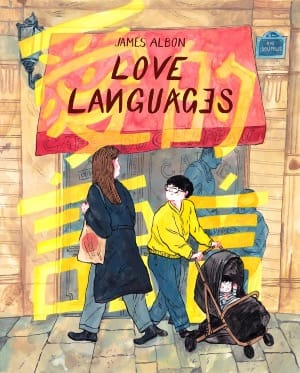
I absolutely loved Love Languages—not just the story, but also its artistic style. The warm and cold tones are used to add an additional layer of understanding and emotion to the narrative that wouldn't otherwise be possible just through the use of words. And the way in which James Albon uses speech bubbles to incorporate translation in the graphic novel is, I think, simply ingenious.
Love Languages so perfectly describes the experience of feeling lost and lonely in a foreign country—only to unexpectedly find friendship, love, and a sense of home. In its depiction of both the excitements and fears that are common to all relationships, it also reveals how hard it can be to find the words to describe your emotions, no matter the language.
We follow Sarah, an accomplished English consultant working in Paris for an American company. Struggling with the French language and culture, her life is literally tinted blue. She feels lonely and unsatisfied, and even her work doesn't bring her happiness. The sophisticated language that she and her colleagues use is void of any meaning, utter corporate gibberish.
It is Ping, a carefree young woman from Hong Kong, that suddenly adds color to Sarah’s life. Their first encounter is awkward—hindered by language barriers—but slowly their relationship evolves into a beautiful friendship, completely transforming Sarah’s perspective on life. Ping, in her bright yellow jacket, it turns out, is the warm ray of sunshine that Sarah needs. And what started as choppy communication blossoms into a language that is uniquely theirs.
As I mentioned, the use of warm and cold tones really works well in the story: Sarah’s world is visually blue and cold until Ping brings warmth and vibrancy to it. And the way characters are depicted is also significant. Sarah's colleagues at work, for example, are almost grotesque, drawn in a style that reminded me of French artist Toulouse-Lautrec. But it’s certainly the way in which James Albon used speech bubbles that struck me the most. He managed to find a way to visually capture Sarah’s growing and varying understanding of French and Cantonese throughout the novel, simply and beautifully. It might need some initial getting used to, but trust me, it quickly flows magically.
⭐ 4.5/5 – Love Languages is an utterly original and enjoyable graphic novel. James Albon beautifully captures how a single person can shift your entire worldview. The story resonated with me deeply, as I too have experienced finding love in a foreign country (and language).
Hostage, by Guy Delisle
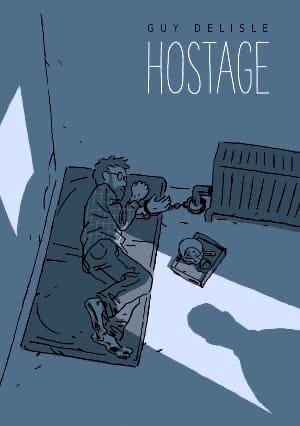
Hostage is one of those graphic novels that lingers in your mind long after you’ve finished it. Guy Delisle, best known for his award-winning graphic novels Pyongyang and Jerusalem, is one of the authors who has helped popularizing the genre of “graphic journalism,” and Hostage is a perfect example of it.
Published in 2017, this chunky graphic novel tells the heart-wrenching true story of Christophe André, a French humanitarian worker kidnapped by a Chechen gang in 1997. And so we follow Christophe in his 111 days of captivity.
His world is reduced to a single room, the only markers of time the gradually shifting light, the daily servings of watery soup, and the occasional trip to the restroom. Told in the first person, the narrative feels like a journal, with a tone that I would describe as almost calm, matter-of-fact. Trapped in a feverish dream of hope and despair, Christophe is faced with many trivial and not-so-trivial thoughts. He feels ashamed of his own weakness. Why does he allow his captors to humiliate him like this? Would he ever see his loved ones again? Would he be back in time for his sister’s wedding?
But the book isn’t all doom and gloom. There are moments of humor and small acts of defiance. We laugh and cheer with him in quiet solidarity as he giddily reclaims some control over his captors.
Until one day, towards the end of the graphic novel, the pace suddenly changes and we find ourselves barely breathing as we rush to the final page to find out if he succeeds in his daring escape.
At times tense, at times unexpectedly funny, this is not an easy read—and it certainly comes with its own trigger warnings—but it’s an important and powerful story that I think everyone should read. Guy Delisle doesn’t shy away from the horror and violence of captivity, but he tells it with such gentleness and respect for the Christophe’s experience that I think many people would enjoy picking it up.
⭐ 4/5 – Both gripping and informative, this is a book I will never forget.
Low Orbit, by Kazimir Lee
(pub date: Apr 29 2025)
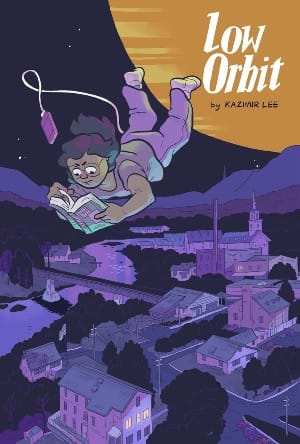
Low Orbit is a beautiful and atmospheric graphic novel by Kazimir Lee. I immediately fell in love with Lee's incredible art that immerses you in its gentle pastel tones - blue and purples - while tackling very important themes, such as identity, dysfunctional relationships, alcoholism, fear and acceptance of oneself and others.
In the graphic novel, we meet fifteen-year-old Azar, who’s recently moved to Vermont with her mother, while her father is still living in New York. Her mom loves her, but she’s also quite traditional. The only thing she’d like is for her daughter to make new friends and do sports to better fit into her clothes. But Azar doesn’t have many friends, her mom doesn’t know that she likes girls, and the only people she seems to be able to open up to are the wacky yet welcoming next-door father-and-son duo: Tristan and Shannon Wathe.
The father and son have a dysfunctional yet deeply heart-warming family dynamic. Tristan, a nonbinary teen who spends a lot of time interacting with the queer and geek communities online, is seventeen. He’s definitely the adult in the family. Shannon, whom Tristan calls by name, once a successful author of sci-fi epic The Exiles of Overworld, now seems determined to never write nor participate in any sci-fi convention again. He mostly hides from his literary agent and, despite being kind and lovely, spends a lot of his time either drinking or engaged in heated interactions online.
But when Azar accidentally finds The Exiles of Overworld, she starts dipping into the fantastical world of Shannon’s imagination. And as things get worse between Azar and her mom, Azar ends up living with Tristan and Shannon, potentially forever altering their family dynamic, as well as her own life. Between trips to the lake, StarCon conventions, cosplays, and New York, the story, full of unexpected twists and surprises, is funny, tender, and emotional.
My only criticism to this graphic novel is that I didn't think the sci-fi novel element worked well in the narrative. The excerpts from The Exiles of Overworld were just too verbose and obscure, and I didn't really understand their connection to the story. The idea of escapism was there, but not well-executed in my opinion.
⭐ 4/5 – Despite a minor flow, I still think Low Orbit is worth reading. It is a gentle ode to finding one's identity while navigating love, affection, and imperfect family relationships. All this while never falling into the pitfall of trying to define. This, I believe, is an achievement worth applauding.